A typical bank of mobile office shelving units offer close to 50% reduction of floor space or a 50% to 100% increase in storage space compared to traditional filing cabinets. The ability to concertina individual units until touching means space is only required between units when they are being accessed by users. Applications with a greater number of simultaneous users may require more access spaces (aisles), thus not approaching this 50% target so closely.
Bay Area, California Office 510-409-1989 | Phoenix, Arizona Office (480) 773-1118
Mobile Aisle System
Mobile Aisle Shelving
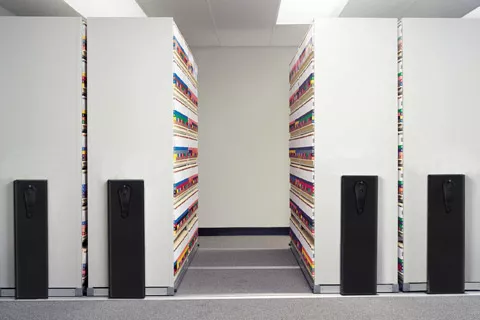
Mobile shelving or roller racking systems are specialised storage units designed to offer increased capacity for a given footprint over traditional storage units.
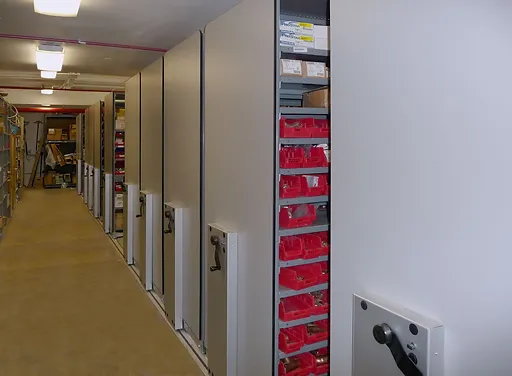
By eliminating the need for an aisle between every shelving unit, more floor space can be utilised for storage. Each unit is mounted on a level trackway (to eliminate gradients in the supporting floor), making it possible to move heavy units with minimal effort. Mobile shelving can be moved manually or by the use of electrical motors.
Manual mobile shelving
Mobile storage systems (mobile aisle shelving or roller racking) are usually constructed with a rotary handle on the exterior accessible face. When rotated, the handle operates the mechanism which winds the single, connected, filing unit either left or right, depending on a clockwise or counter-clockwise rotation of the handle. In an office, for example, several stacks of moveable filling cabinets may be accommodated in a limited space.
Powered mobile shelving
Powered shelving is electrically powered. Units normally have a small AC or DC motor hidden in the base that automatically moves the units when a single button is pressed. High-end versions connect into archiving databases, and using RFID allow the easy retrieval of archived items with auto-open and close functions.
Applications
Mobile aisle shelving is typically used for academic or commercial applications where a significant volume of physical archive material, filing or books are to be stored. These include medical or government records, file-intensive offices such as the legal or accountancy professions, and public and academic libraries and similar archives.
Another common use is in retail stockrooms to maximise the stock capacity, or to reduce the back of house storage space required so that a greater proportion of the overall shop space can be used for customer retail purposes.